Build an Efficient Exam Workflow for SCR & CFA SIC
Balancing a demanding professional career with the rigorous requirements of the GARP Sustainability and Climate Risk (SCR) exam or the CFA Institute’s Certificate in ESG Investing (SIC) exam is genuinely difficult. Most professionals who struggle with these certifications do not fail because of knowledge gaps alone. They fail because their preparation workflow is disorganized, reactive, and unsustainable over weeks of study. A structured, personalized workflow changes this entirely. This guide provides a step-by-step approach to building a preparation system that fits around real professional schedules and drives measurable results for both the SCR and CFA SIC exams.
Table of Contents
- Assess your starting point and requirements
- Map your workflow: Scheduling and task management
- Active learning and review strategies for sustainability content
- Monitor progress and adjust for peak performance
- Why most exam prep workflows fail and what really works for SCR and CFA SIC
- Take the next step: Get exam-ready with tailored resources
- Frequently asked questions
Key Takeaways
| Point | Details |
|---|---|
| Self-assessment first | Evaluate your strengths and weaknesses to focus your workflow and reduce wasted study time. |
| Batch and prioritize tasks | Use weekly modules and task batching for better time management and stress reduction. |
| Active, collaborative learning | Mix solo recall, group review, and mock exams for efficient mastery of sustainability topics. |
| Track and adapt | Regularly monitor progress and adjust your approach for consistent improvement. |
Assess your starting point and requirements
With the challenges clear, let’s map out how to begin building a custom preparation plan.
Before scheduling a single study session, professionals need an honest assessment of where they currently stand. This is not about confidence. It is about data. Knowing which sustainability and climate risk topics are already familiar, and which require intensive attention, allows for a targeted preparation strategy rather than a generic one. For example, a risk manager with five years of experience in physical climate risk modeling will approach the SCR syllabus very differently from a compliance officer who is new to Task Force on Climate-related Financial Disclosures (TCFD) frameworks.
A practical starting point is to obtain the official exam syllabus and map each topic against personal experience. Rate each area on a simple three-tier scale: strong, familiar, or unfamiliar. This alone will shape the entire workflow that follows.
Essential materials to gather before beginning preparation:
- The official GARP SCR or CFA SIC syllabus document
- High-quality free SCR summary notes that condense the full syllabus
- A reliable question bank with exam-style practice questions
- A digital or physical notebook for concept mapping
- Access to at least one full mock exam for baseline testing
Once materials are assembled, the next decision is which organizational tools to use. Digital project management apps such as Notion or Trello allow professionals to track modules, flag weak areas, and attach resources directly to tasks. Traditional checklists work well for those who prefer a tactile review system. Neither approach is superior in isolation. What matters is consistency of use.
Effective exam workflows for sustainability certifications consistently emphasize the value of beginning with an upfront diagnostic rather than diving straight into reading. Taking a short self-assessment on each syllabus section, even informally scoring knowledge on a scale from one to five, surfaces blind spots that might not emerge until weeks later under time pressure.
| Topic area | Self-rating (1 to 5) | Priority level |
|---|---|---|
| Climate risk fundamentals | 4 | Medium |
| ESG integration frameworks | 2 | High |
| Regulatory and reporting standards | 3 | Medium |
| Climate scenario analysis | 1 | Critical |
| Sustainable investing strategies | 3 | Medium |
This table becomes a living document, updated as preparation progresses. The exam strategies blog at Green Risk Education offers additional frameworks for structuring this diagnostic phase effectively.
Pro Tip: Run a timed baseline mock exam in week one, before any structured study begins. The score matters far less than the topic breakdown. Use it as a map, not a measure of readiness.
Map your workflow: Scheduling and task management
Once materials and tools are in place, the next step is to build a schedule that actually works for busy professionals.
Scheduling is where most preparation workflows collapse. Professionals frequently underestimate how long topics take to process, overload individual sessions, and then abandon the schedule entirely by week three. The solution is not willpower. It is better workflow architecture.
Begin by calculating total available study hours between now and exam date. Then divide the syllabus into weekly modules that respect that limit. For context, study time for the CFA ESG exam typically falls between 80 and 120 hours for most candidates, though this varies significantly based on prior ESG exposure. Knowing this figure prevents both under-preparation and the burnout that comes from trying to cram too much into too short a window.
Step-by-step workflow scheduling process:
- Confirm the exam date and count available weeks from today.
- Map the full syllabus into roughly equal thematic modules.
- Assign one primary module per week, with one review session built in.
- Block specific days and times in a calendar app as non-negotiable study periods.
- Add practice test sessions at weeks two, four, and six, or equivalent intervals.
- Schedule a full mock exam two weeks before the exam date.
- Reserve the final week for targeted review of persistently weak areas only.
Applying task prioritization techniques from established productivity frameworks improves scheduling accuracy. Batch scheduling, grouping similar cognitive tasks such as reading and note-taking into the same session, reduces the mental overhead of context-switching. Block scheduling, dedicating uninterrupted time blocks of 60 to 90 minutes to deep content work, suits complex sustainability topics like climate scenario analysis and integrated ESG risk assessment particularly well.
Comparison of scheduling approaches:
| Approach | Best for | Limitation |
|---|---|---|
| Digital planning tools (Notion, Trello) | Visual learners, multi-device access | Requires setup time |
| Traditional paper checklists | Quick daily task tracking | Less adaptable for changes |
| Calendar blocking (Google Calendar) | Deadline-driven professionals | Can feel rigid without buffer |
| Hybrid (digital plan + paper checklist) | Most working professionals | Requires light maintenance |
Integrating regular practice tests into the schedule from an early stage is critical. Many candidates make the error of treating mock exams as an end-of-study activity. In reality, early practice tests expose knowledge gaps while there is still time to address them. Free CFA ESG mock exams and practice question sets provide realistic performance checks without the pressure of the actual exam setting.

Pro Tip: When building the schedule, add a 20% buffer to every weekly module. If a topic takes six hours to cover properly instead of five, that buffer absorbs the overage without cascading disruption across the entire plan.
Active learning and review strategies for sustainability content
With a schedule in place, the most effective ways to absorb and internalize key exam content come into focus.
Reading through sustainability content once is rarely sufficient for retention, particularly when topics intersect across disciplines, such as when physical climate risk connects to asset valuation methodologies and portfolio-level ESG integration. Active learning strategies convert passive reading into durable knowledge.
Active recall involves testing memory of a concept before reviewing the source material. After reading about transition risk categories, professionals should close their notes and attempt to write out the key points from memory. This friction is intentional. The act of retrieval, even imperfect retrieval, strengthens neural encoding far more effectively than rereading.
Spaced repetition distributes review sessions for the same concept across increasing time intervals. Reviewing climate scenario analysis frameworks on day one, then day three, then day seven, and again two weeks later builds long-term retention at a fraction of the time required by massed study. Flashcard apps like Anki support this approach well for terminology-heavy content such as ESG reporting standards and regulatory frameworks.
Key active learning practices for SCR and CFA SIC preparation:
- Write concept summaries in plain language after each study session
- Use structured question prompts before reviewing notes
- Sketch diagrams or frameworks from memory to check understanding
- Attempt past practice questions before completing topic reading
- Return to master exam strategies periodically to recalibrate approach
Peer discussions and collaborative review deserve serious consideration. Study groups, even small ones of two or three professionals with overlapping exam timelines, create accountability and expose knowledge gaps that solo study often misses. Collaborative learning approaches consistently surface as an accelerator for exam performance, particularly in content areas requiring application rather than pure recall.
Teaching a concept to someone else is the fastest way to discover what you do not yet fully understand. If a concept cannot be explained in simple terms, it has not been mastered. Build this practice into every study module.
Summary notes serve a different but equally important function. Rather than replacing deep study, concise summary materials allow professionals to conduct rapid content refreshes in the final weeks before the exam. A well-structured summary note that covers an entire syllabus section in four to six pages can be reviewed in under thirty minutes, making it ideal for the high-frequency review sessions that immediately precede the exam.
Mock exams, simulating the actual format and time constraints of the SCR or CFA SIC exam, should be treated as performance diagnostics rather than final tests. Two to three full mock exams across the preparation period, each followed by a careful review of incorrect answers, build both content accuracy and exam technique simultaneously.
Monitor progress and adjust for peak performance
Applying active learning is vital, but optimizing a workflow requires continuous adjustment.
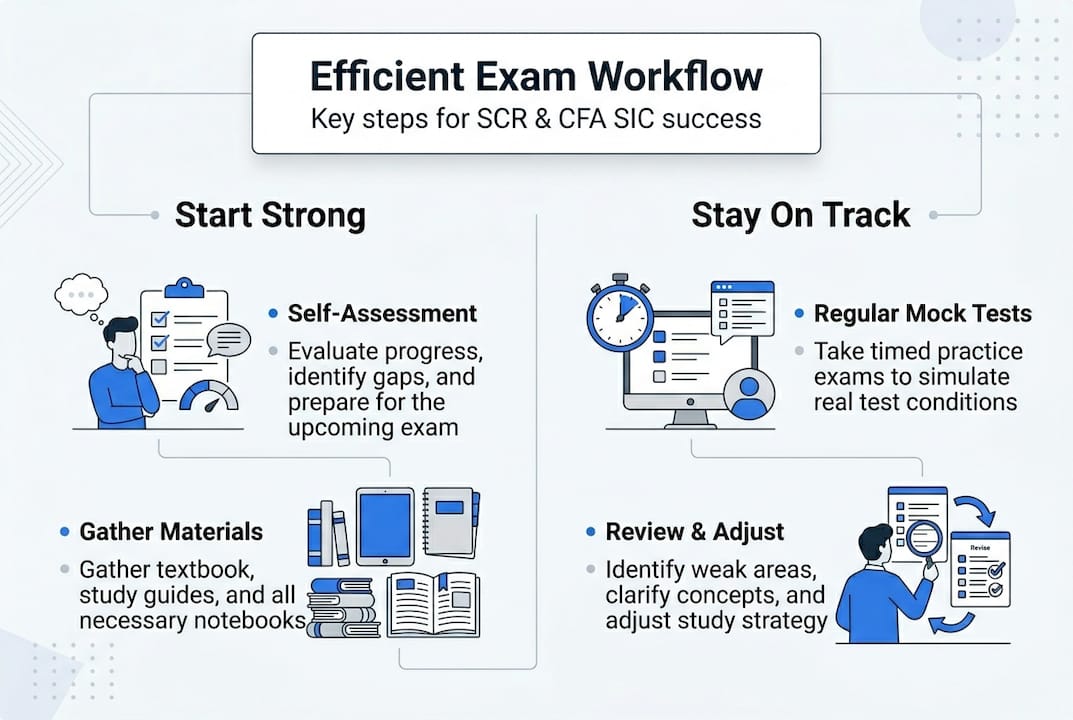
A static preparation plan does not survive contact with real professional life. Unexpected project deadlines, travel, and cognitive fatigue all affect study output. The solution is a lightweight monitoring system that flags when the plan is drifting before the drift becomes critical.
| Week | Module completed | Mock exam score | Weak areas identified | Adjustment made |
|---|---|---|---|---|
| 1 | Climate risk fundamentals | 52% | Scenario analysis | Added extra session |
| 2 | ESG integration frameworks | 58% | Reporting standards | Swapped reading for Q&A |
| 3 | Regulatory landscape | 61% | TCFD alignment | Group discussion added |
| 4 | Sustainable finance | 67% | None critical | Maintained current plan |
This kind of self-monitoring table takes five minutes to update each week and provides a clear longitudinal view of progress. Time-saving exam practices that enable candidates to stay on schedule emphasize this type of structured self-review as a key differentiator between candidates who pass on their first attempt and those who require multiple sittings.
Common workflow mistakes and practical fixes:
- Skipping full mock exams: Replace with a minimum of two timed mocks at weeks four and seven of preparation.
- Over-relying on passive reading: Limit reading-only sessions and require an active output such as a summary or self-quiz at the end of every session.
- Ignoring persistent weak areas: Schedule a dedicated “weak area sprint” session each week based on the monitoring table.
- Neglecting exam technique: Practice answering under time pressure from week two onward, not just in the final stretch.
- Treating the plan as fixed: Review and adjust the schedule every two weeks based on actual performance data.
Exam success checklists and structured review frameworks support this adjustment process by providing external reference points for what effective preparation looks like at each stage.
Pro Tip: Post a brief description of a specific workflow bottleneck, such as difficulty retaining ESG reporting standards, in a relevant LinkedIn group or study forum. Crowdsourced fixes from others who have passed the same exam often surface faster solutions than extended solo troubleshooting. The professional community for SCR and CFA SIC exam ROI discussions is active and genuinely helpful.
Why most exam prep workflows fail and what really works for SCR and CFA SIC
Having covered the workflow formula, here is a candid reflection on what truly moves the efficiency needle.
Generic study schedules, the kind downloaded from the internet or copied from a friend in a different field, consistently underperform for sustainability certification candidates. The reason is structural. A schedule built around standardized time blocks and linear topic progression ignores the highly interconnected nature of SCR and CFA SIC content, where climate risk, ESG governance, and financial analysis frameworks constantly overlap and reinforce one another.
The most effective workflows in this space share two characteristics that most guides overlook. First, they are built around feedback loops, not just calendars. Candidates who adjust their approach based on weekly practice test results consistently outperform those who follow a fixed plan regardless of performance data.
Second, high-yield mini reviews, short 10 to 15 minute sessions reviewing a single concept or framework immediately before or after a regular work day, drive retention out of proportion to the time invested. Most professionals underestimate this entirely and focus only on weekend deep-study sessions. Comparing the CFA ESG versus SCR credentials and their respective learning demands further clarifies which approach fits which career context. Iteration and real-time feedback are the real differentiators. Content volume alone rarely determines outcomes.
Take the next step: Get exam-ready with tailored resources
Ready to accelerate exam preparation? Put proven workflow strategies into practice with these specialized tools.
Green Risk Education provides a full suite of resources designed specifically for SCR and CFA SIC candidates who need to study efficiently without sacrificing depth. The platform’s online SCR and CFA ESG courses deliver structured, syllabus-aligned content through bite-sized video lessons that fit into even the most demanding professional schedule. Each resource is built for exam-specific efficiency, covering the exact frameworks, risk categories, and ESG standards that appear in both exams.
For candidates who want to begin immediately, free SCR summary notes offer a condensed, exam-focused starting point that can be integrated directly into the workflow outlined in this guide. From practice questions and mock exams to detailed concept summaries, every resource on the platform is designed to reduce preparation time while maximizing exam performance.
Frequently asked questions
How long should I spend preparing for the GARP SCR or CFA SIC exams?
Most professionals require 80 to 120 focused hours, but workflow structure and consistency matter more than raw hours invested over a longer, disorganized period.
What tools or resources are best for an efficient exam workflow?
High-quality summary notes, official practice questions, digital planning tools, and workflow tracking tables are the most effective resources, particularly when aligned with proven SCR question techniques and exam-specific methodology.
How can I avoid burnout during exam preparation?
Building in short breaks between study sessions, varying formats between reading, practice questions, and group discussion, and reviewing the workflow weekly to recalibrate energy use are the most reliable safeguards against burnout during extended exam prep.
Is group study effective for the GARP SCR or CFA SIC exams?
Group discussions and collaborative review sessions accelerate learning and significantly improve retention of complex sustainability topics, as collaborative study methods consistently support stronger performance outcomes in ESG-focused certification exams.
Recommended

Copyright © Green Risk Education 2026